Neo4j程序访问
Neo4j数据库访问
Neo4j访问的两种方式
- 嵌入式数据库
- 服务器模式(通过REST的访问)
它是由应用程序的性质(neo4j是独立服务器 还是和程序在一起),性能,监控和数据安全性来决定架构选择。
An embedded database(嵌入式数据库)
嵌入式Neo4j数据库是性能的最佳选择。 通过指定数据存储的路径以编程方式访问嵌入式数据库。
我们选择嵌入式数据库出于以下原因:
- 使用Java作为我们项目的编程语言时
- 应用程序是独立的
程序追求很高的性能
Neo4j Server(服务器模式)
Neo4j Server是相互操作性,安全性和监控的最佳选择。 实际上,REST接口允许所有现代平台和编程语言与它进行互操作。 此外,作为独立应用程序,它比嵌入式配置更安全(客户端中的潜在故障不会影响服务器),并且更易于监控。 如果我们选择使用这种模式,我们的应用程序将充当Neo4j服务器的客户端。要连接到Neo4j服务器,可以使用任何编程语言的REST访问数据库。
Java客户端操作Neo4j
嵌入式模式
<dependency>
<groupId>org.neo4j</groupId>
<artifactId>neo4j</artifactId>
<version>3.5.5</version>
</dependency>
package com.neodemo; import org.neo4j.graphdb.*; import org.neo4j.graphdb.factory.GraphDatabaseFactory; import java.io.File; import java.util.HashMap; import java.util.Map; public class EmbeddedNeo4jAdd { private static final File databaseDirectory = new File( "target/graph.db" ); public static void main(String[] args) { GraphDatabaseService graphDb = new GraphDatabaseFactory().newEmbeddedDatabase(databaseDirectory); System.out.println("Database Load!"); Transaction tx = graphDb.beginTx(); Node n1 = graphDb.createNode(); n1.setProperty("name", "张三"); n1.setProperty("character", "A"); n1.setProperty("gender",1); n1.setProperty("money", 1101); n1.addLabel(new Label() { @Override public String name() { return "Person"; } }); String cql = "CREATE (p:Person{name:'李四',character:'B',gender:1,money:21000})"; graphDb.execute(cql); tx.success(); tx.close(); System.out.println("Database Shutdown!"); graphDb.shutdown(); } }package com.neodemo; import org.neo4j.graphdb.*; import org.neo4j.graphdb.factory.GraphDatabaseFactory; import java.io.File; import java.util.HashMap; import java.util.Map; public class EmbeddedNeo4jQueryAll { private static final File databaseDirectory = new File( "target/graph.db" ); public static void main(String[] args) { GraphDatabaseService graphDb = new GraphDatabaseFactory().newEmbeddedDatabase(databaseDirectory); System.out.println("Database Load!"); String cql = "MATCH (a:Person) where a.money < $money return a"; Map<String, Object> paramerters = new HashMap<String, Object>(); paramerters.put("money", 25000); Transaction tx = graphDb.beginTx(); Result result = graphDb.execute(cql,paramerters); while (result.hasNext()) { Map<String, Object> row = result.next(); for (String key : result.columns()) { Node nd = (Node) row.get(key); System.out.printf("%s = %s:%s%n", key, nd.getProperty("name"),nd.getProperty("money")); } } tx.success(); tx.close(); System.out.println("Database Shutdown!"); graphDb.shutdown(); } }服务器模式
<dependency>
<groupId>org.neo4j</groupId>
<artifactId>neo4j-ogm-bolt-driver</artifactId>
<version>3.2.10</version>
</dependency>
package com.neodemo; import org.neo4j.driver.*; import static org.neo4j.driver.Values.parameters; public class Neo4jServerMain { public static void main(String[] args) { Driver driver = GraphDatabase.driver( "bolt://127.0.0.1:7687", AuthTokens.basic( "neo4j", "123456" ) ); Session session = driver.session(); String cql = "MATCH (a:Person) WHERE a.money > $money RETURN a.name AS name, a.money AS money order by a.money "; Result result = session.run( cql, parameters( "money", 1000 ) ); while ( result.hasNext() { Record record = result.next(); System.out.println( record.get( "name" ).asString() + " " + record.get( "money" ).asDouble() ); } session.close(); driver.close(); } }package com.neodemo; import org.neo4j.driver.*; import static org.neo4j.driver.Values.parameters; public class Neo4jServerMain2 { public static void main(String[] args) { Driver driver = GraphDatabase.driver( "bolt://127.0.0.1:7687", AuthTokens.basic( "neo4j", "123456" ) ); Session session = driver.session(); String cql = "MATCH p=shortestPath((person:Person {name:$startName})-[*]-(person2:Person {name:$endName} )) RETURN p"; Result result = session.run( cql,parameters("startName","王启年","endName","九品射手燕小乙") ); while ( result.hasNext() ) { Record record = result.next(); System.out.println(record); } session.close(); driver.close(); } }SpringBoot 整合Neo4j
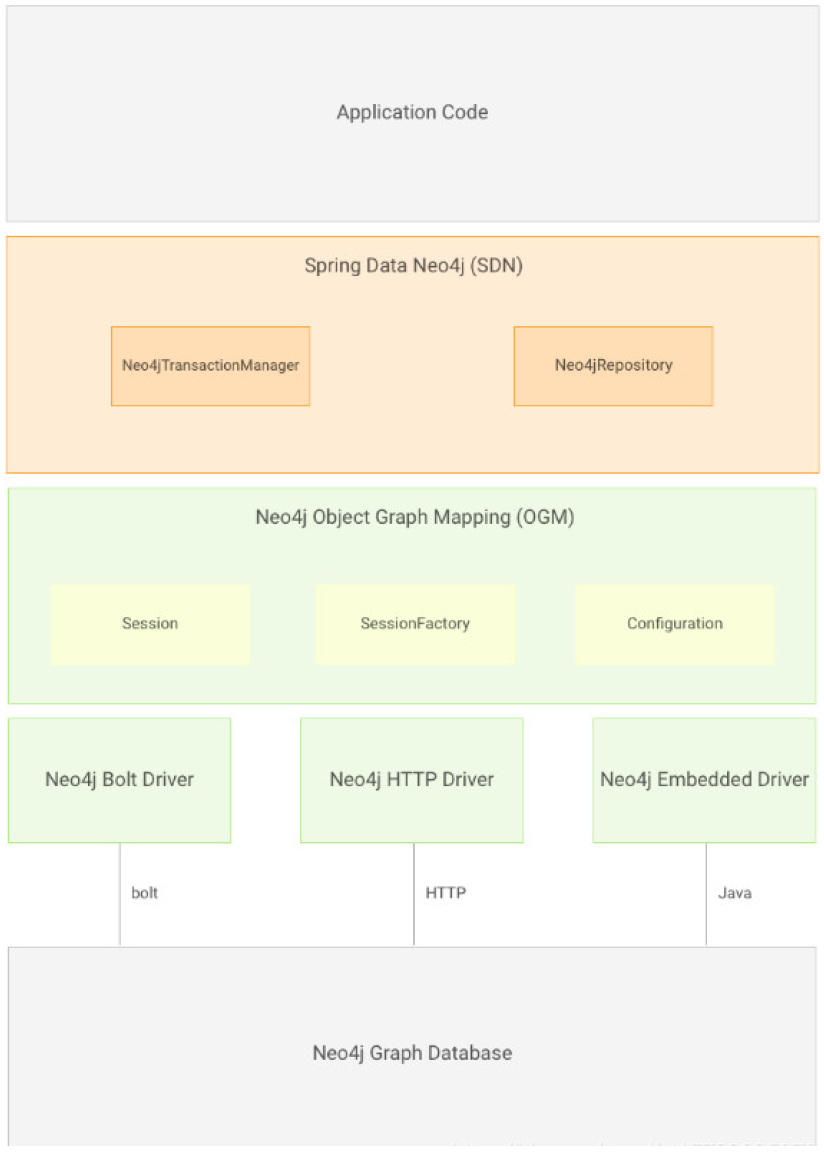
导入jar包
<?xml version="1.0" encoding="UTF-8"?>
<project xmlns="http://maven.apache.org/POM/4.0.0"
       xmlns:xsi="http://www.w3.org/2001/XMLSchema-instance"
             xsi:schemaLocation="http://maven.apache.org/POM/4.0.0
                                 http://maven.apache.org/xsd/maven-4.0.0.xsd">

<modelVersion>4.0.0</modelVersion>

<groupId>com.neodemo</groupId>
<artifactId>neo4j_springboot_demo</artifactId>
<version>1.0-SNAPSHOT</version>

<parent>
  <groupId>org.springframework.boot</groupId>
  <artifactId>spring-boot-starter-parent</artifactId>
  <version>2.0.5.RELEASE</version>
</parent>

<properties>
  <project.build.sourceEncoding>UTF-8</project.build.sourceEncoding>
  <project.reporting.outputEncoding>UTF-8</project.reporting.outputEncoding>
  <java.version>1.11</java.version>
</properties>

<dependencies>
  <!--这个包默认使用了bolt协议-->
  <dependency>
    <groupId>org.springframework.boot</groupId>
    <artifactId>spring-boot-starter-data-neo4j</artifactId>
  </dependency>
  <!--如果使用bolt协议可以不导入这个包,使用http协议和嵌入式方式必须导入这个包-->
  <dependency>
    <groupId>org.neo4j</groupId>
    <artifactId>neo4j-ogm-bolt-driver</artifactId>
  </dependency>
</dependencies>

<build>
  <plugins>
    <plugin>
      <groupId>org.springframework.boot</groupId>
      <artifactId>spring-boot-maven-plugin</artifactId>
    </plugin>
  </plugins>
</build>

</project>
建立实体类
package com.neodemo.bean;

import org.neo4j.ogm.annotation.GeneratedValue;
import org.neo4j.ogm.annotation.Id;
import org.neo4j.ogm.annotation.NodeEntity;
import org.neo4j.ogm.annotation.Property;

@NodeEntity
public class Person {
@Id
@GeneratedValue
private Long id;
@Property("cid") // 数据库和实体属性不对应时,用此注解
private int pid;
@Property // 数据库和实体属性对应时,可以不用此注解
private String name;
private String character;
private double money;
private int gender;
private int age;
private String description;
@Relationship(type = "Friends",direction = Relationship.INCOMING)
private Set<Person> relationPersons;

@Override
public String toString() {
  return "Person{" +
  "id=" + id +
  ", pid=" + pid +
  ", name='" + name + '\'' +
  ", character='" + character + '\'' +
  ", money=" + money +
  ", gender=" + gender +
  ", age=" + age +
  ", description='" + description + '\'' +
  ", relationPersons=" + relationPersons +
  '}';
}

public Person() {

}

public Person(Long id, String name, String character, double money, int gender, int age, String description) {
  this.id = id;
  this.name = name;
  this.character = character;
  this.money = money;
  this.gender = gender;
  this.age = age;
  this.description = description;
}

public Set<Person> getRelationPersons() {
  return relationPersons;
}

public void setRelationPersons(Set<Person> relationPersons) {
  this.relationPersons = relationPersons;
}

public Long getId() {
  return id;
}

public void setId(Long id) {
  this.id = id;
}

public String getName() {
  return name;
}

public void setName(String name) {
  this.name = name;
}

public String getCharacter() {
  return character;
}

public void setCharacter(String character) {
  this.character = character;
}

public double getMoney() {
  return money;
}

public void setMoney(double money) {
  this.money = money;
}

public int isGender() {
  return gender;
}

public void setGender(int gender) {
  this.gender = gender;
}

public int getAge() {
  return age;
}

public void setAge(int age) {
  this.age = age;
}

public String getDescription() {
  return description;
}

public void setDescription(String description) {
  this.description = description;
}

}
数据持久化类
package com.neodemo.repository;

import com.neodemo.bean.Person;
import org.springframework.data.neo4j.annotation.Query;
import org.springframework.data.neo4j.repository.Neo4jRepository;
import org.springframework.stereotype.Repository;

import java.util.*;

@Repository
public interface PersonRepository extends Neo4jRepository<Person,Long> {

@Query("match(p:Person) where p.money > {0} return p")
List<Person> personList(double money);

@Query("MATCH p=shortestPath((person:Person {name:{0}})-[*1..4]-(person2:Person {name:{1}}) ) RETURN p")
List<Person> shortestPath(String startName,String endName);

}
或者使用
@Query("match(p:Person) where p.money>{money} return p")
List<Person> personList(@Param("money") double money);

// 指定开始的名字 和 结束的名字 查询最短路径 限定深度为4以内包含4
@Query("match p=shortestPath((person:Person{name:{startName}})-[*1..4]-(person2:Person {name:{endName}})) return p")
List<Person> shortestPath(@Param("startName") String startName,@Param("endName") String endName);
配置文件 application.yml
spring:
data:
  neo4j:
    username: neo4j
    password: 123456
    uri: bolt://192.168.211.133:7687
    #uri: http://192.168.211.133:7474
    #uri: file:///target/graph.db
编写服务类
package com.neodemo.service;

import com.neodemo.bean.Person;
import com.neodemo.repository.PersonRepository;
import org.springframework.beans.factory.annotation.Autowired;
import org.springframework.stereotype.Service;

import java.util.*;

@Service
public class Neo4jPersonService {

@Autowired
private PersonRepository personRepository;

public List<Person> personList(){
  return personRepository.personList();
}

public Person save(Person person){
  return personRepository.save(person);
}

public List<Person> shortestPath(String startName, String endName){
  return personRepository.shortestPath(startName,endName);
}

}
编写测试类
package com.neodemo;

import com.neodemo.bean.Person;
import com.neodemo.service.Neo4jPersonService;
import org.springframework.boot.SpringApplication;
import org.springframework.boot.autoconfigure.SpringBootApplication;
import org.springframework.context.ApplicationContext;

import java.util.List;

@SpringBootApplication
public class TestNeo4jBootApp {

public static void main(String[] args) {
  ApplicationContext app = SpringApplication.run(TestNeo4jBootApp.class,args);
  Neo4jPersonService personService = app.getBean(Neo4jPersonService.class);
  System.out.println(personService);
  List<Person> datas = personService.personListAll();
  System.out.println(datas);
  System.out.println(personService. shortestPath("王启年", "九品射手燕小乙"));
}

}
评论已关闭